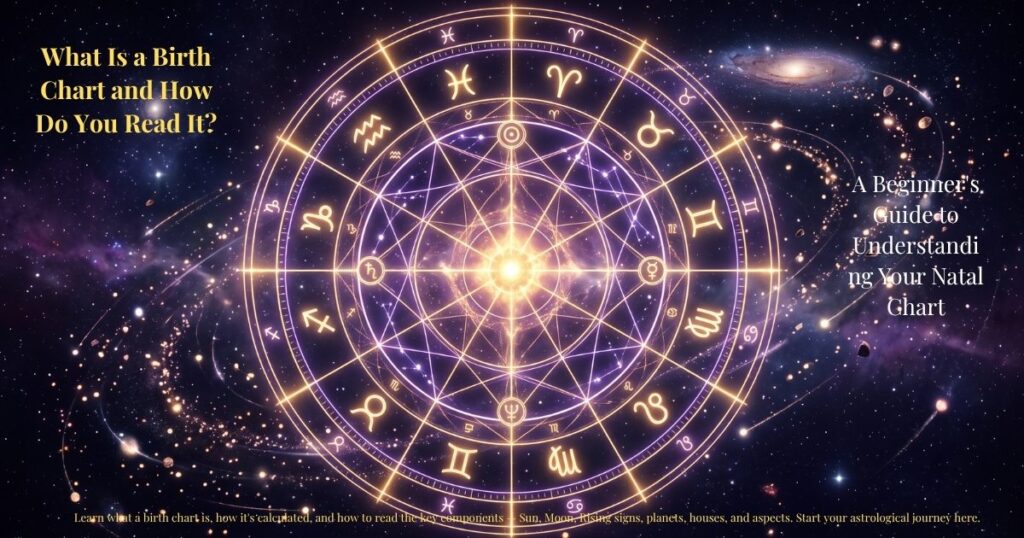
What Is a Birth Chart and How Do You Read It?

If you’ve ever read your horoscope and thought, “That doesn’t sound like me at all,” you’re not alone. Sun sign horoscopes — the kind you see in magazines and apps — are based on only one placement in a much larger cosmic picture. Your birth chart (also called a natal chart) is the complete map of the sky at the exact moment and location of your birth, and it reveals a level of detail about your personality, relationships, career, and life purpose that your Sun sign alone never could.
Think of your Sun sign as the title of a book. Your birth chart is every single page inside — the chapters, the subplots, the character development. It shows not just who you are, but why you are the way you are, where your strengths and challenges lie, and what you’re here to learn. When you combine birth chart insights with your Life Purpose Finder results, you begin to see the full blueprint of your existence.
In this guide, you’ll learn what a birth chart actually is, the meaning of each component (planets, signs, houses, and aspects), and a step-by-step method to start reading your own chart. You can generate your complete birth chart for free using the Zodiaxon Birth Chart Calculator, which gives you a beautifully visualised chart along with detailed interpretations. For an even deeper dive into your specific zodiac sign, try our Zodiac Sign Deep Dive tool after reading this guide.
📖 In This Guide
- What Exactly Is a Birth Chart?
- Why Your Birth Chart Matters More Than Your Sun Sign
- The Three Essential Components: Planets, Signs, and Houses
- Meet the Planets: The Characters in Your Cosmic Story
- The 12 Zodiac Signs: How Each Planet Expresses Itself
- The 12 Houses: The Stages Where Your Life Unfolds
- Step-by-Step: How to Read Your Birth Chart
- The Big Three: Sun, Moon, and Rising Sign Explained
- Understanding Planetary Aspects: The Cosmic Conversations
- Common Mistakes Beginners Make When Reading Charts
- How to Use Your Birth Chart in Daily Life
- Final Thoughts: Your Chart Is a Mirror, Not a Cage
1. What Exactly Is a Birth Chart?
A birth chart — also called a natal chart or horoscope chart — is essentially a snapshot of the sky at the precise moment you were born, calculated from your exact birth date, birth time, and birth location. Imagine freezing the entire solar system at the second of your first breath: the Sun, Moon, and every planet in our solar system was positioned somewhere specific in the sky, occupying a particular zodiac sign and a particular astrological house. That frozen moment, drawn as a 360-degree wheel divided into 12 segments, is your birth chart.
Astrologers read this wheel like a map. The symbols (called glyphs) represent the planets; the outer ring shows the zodiac signs; the inner pie-slices are the houses. Lines crisscrossing the centre reveal aspects — the angular relationships between planets that describe how different parts of your personality interact. If you’ve already explored your Zodiac Sign in depth, your birth chart will show you that you’re not just one sign — you’re an entire cosmic committee. You can generate your personalised chart instantly with our Birth Chart Calculator.
The birth chart is the foundational tool of Western astrology. It’s used not just for personality analysis but also for timing major life decisions (through transits and progressions), understanding relationships (through synastry, which you can explore using our Love Compatibility Calculator), and even for career guidance (our Career Path Finder incorporates birth chart data for deeper alignment).
2. Why Your Birth Chart Matters More Than Your Sun Sign
Here’s a startling fact that surprises most beginners: your Sun sign is only about 10% of your astrological makeup. When someone says “I’m a Leo” or “I’m a Pisces,” they’re referring to where the Sun was on the day they were born. But on that same day, the Moon was in a different sign. Mercury was in another. Venus, Mars, Jupiter, Saturn — every planet was somewhere unique. And then there’s your Rising sign (Ascendant), which changes approximately every two hours, making it hyper-personal to your exact birth time.
This is why two people born on the same day can have radically different personalities. A person born at 3:00 AM with a Capricorn Rising will present very differently from someone born at 3:00 PM on the same day with a Leo Rising — even though they share the same Sun sign. The birth time determines the house placements and the Ascendant, which in turn influences how every planet expresses itself in your life. You can explore these nuances with our Birth Chart Calculator — it’s the difference between a sketch and a high-resolution photograph of your soul.
Your birth chart also explains apparent contradictions in your personality. Ever felt like a “shy extrovert” or a “practical dreamer”? That’s likely your chart showing multiple planetary influences. Our Shadow Personality Test can help you identify the parts of your chart that even you may not be consciously aware of, while the Personal Growth AI Coach synthesises your chart into actionable insights.
3. The Three Essential Components: Planets, Signs, and Houses
Every birth chart is built from three fundamental building blocks. Understanding these three layers — and how they interact — is the key to reading any chart. Here’s a simple framework to remember them:
Planets = The WHAT
The planets represent different parts of your psyche — your ego (Sun), emotions (Moon), communication style (Mercury), love nature (Venus), drive (Mars), and so on. They are the characters in your story.
Signs = The HOW
The zodiac signs colour how each planet expresses itself. Mars in Aries is bold and impulsive; Mars in Cancer is protective and indirect. Same planet, entirely different expression. For a focused study of your sign, use our Zodiac Sign Deep Dive tool.
Houses = The WHERE
The 12 houses represent different life areas — career, relationships, home, creativity, spirituality. A planet in the 10th house of career will express very differently than the same planet in the 4th house of home and family.
The magic of astrology happens when you combine all three. For example: Venus (planet of love) in Taurus (a sensual, earthy sign) in the 7th house (partnerships) suggests someone who expresses love through physical affection and material stability, and for whom romantic partnership is a central life theme. Each combination tells a unique story — that’s why your chart is as individual as your fingerprint.
4. Meet the Planets: The Characters in Your Cosmic Story
In astrology, there are ten primary planetary bodies used in chart interpretation (the Sun and Moon are called “luminaries” but are often grouped with the planets for simplicity). Each governs a specific domain of human experience. Here are the most important ones to know when you start reading your chart:
☀️ Sun — Your Core Identity and Life Force
The Sun represents your conscious self, your ego, your vitality, and your core personality. It’s what you’re growing into over your lifetime. Its sign is your “Sun sign” — the one you already know. Its house shows the life area where you shine brightest. A Sun in the 10th house, for instance, suggests someone destined for public visibility or leadership. Pair this insight with our Destiny Potential Score to understand how your core identity aligns with your life’s grand purpose.
🌙 Moon — Your Emotional World and Inner Child
The Moon governs your emotions, instincts, subconscious patterns, and what you need to feel emotionally safe and nurtured. It’s the part of you that only close loved ones see. Your Moon sign often describes your relationship with your mother or primary caregiver. A Moon in Scorpio, for example, feels everything intensely and needs deep emotional merging. To understand your emotional landscape better, try our Emotional Energy Report, which incorporates your Moon placement for a comprehensive emotional profile.
🗣️ Mercury — How You Think and Communicate
Mercury rules thinking, communication, learning style, and how you process information. It never travels more than 28° from the Sun, so your Mercury sign can only be the same sign as your Sun, one sign before, or one sign after. Mercury in Gemini thinks quickly and loves variety; Mercury in Capricorn thinks methodically and communicates with authority. During Mercury Retrograde periods, this planet’s energy turns inward — our survival kit tool helps you navigate those cycles with awareness of your natal Mercury placement.
💖 Venus — How You Love and What You Value
Venus describes your love nature, your aesthetic preferences, what you find beautiful, and how you attract and experience pleasure — both romantic and material. It also governs your relationship with money and possessions. Venus in Libra values harmony, beauty, and partnership; Venus in Aries values independence, pursuit, and excitement. Understanding your Venus placement is essential for relationships — combine it with our Love Compatibility Calculator to see how your love style meshes with a partner’s.
⚡ Mars — Your Drive, Ambition, and Anger
Mars is the planet of action, desire, aggression, and sexual energy. It describes how you go after what you want, how you assert yourself, and how you handle conflict. Mars in Leo is dramatic, generous, and wants recognition; Mars in Virgo is precise, service-oriented, and may express anger through criticism. Mars placement is also extremely relevant for career — our Career Path Finder analyses your Mars along with other chart factors to identify professions where your natural drive can flourish.
🪐 Jupiter & Saturn — Growth and Discipline
Jupiter is the planet of expansion, luck, wisdom, and abundance. It shows where you experience growth, optimism, and opportunity. Saturn is the planet of discipline, restriction, life lessons, and mastery. It shows where you face challenges that, once overcome, become your greatest strengths. Together, they represent the balance between abundance and responsibility. Our Manifestation Readiness Score analyses your Jupiter and Saturn to assess your capacity to attract and sustain abundance.
5. The 12 Zodiac Signs: How Each Planet Expresses Itself
The zodiac signs are not just personality types — they’re better understood as modes of expression. A planet in Aries expresses itself directly, impulsively, and courageously. That same planet in Pisces expresses itself subtly, intuitively, and compassionately. Neither is better or worse; they’re simply different frequencies. Every sign is also associated with one of the four elements (Fire, Earth, Air, Water) and one of the three modalities (Cardinal, Fixed, Mutable), which adds another layer of interpretation.
When you look at your chart, pay attention to the balance of elements. Someone with many planets in Water signs will be deeply emotional and intuitive; someone with a predominance of Air signs will be intellectual and communicative. A lack of an element is just as telling as an abundance — it often points to a life area where growth is needed. For a detailed exploration of your dominant sign energies, use our Zodiac Sign Deep Dive tool alongside your chart.
6. The 12 Houses: The Stages Where Your Life Unfolds
If the planets are the characters and the signs are their costumes, the houses are the stages where the drama of your life plays out. There are 12 houses, each governing a specific life domain. The house a planet occupies tells you where that planet’s energy will manifest most visibly.
Planets clustered in a particular house emphasise that life area dramatically. For instance, several planets in the 10th house almost always point to a life centred around career and public achievement — our Career Path Finder can help you translate that emphasis into concrete direction. Meanwhile, empty houses don’t mean those life areas are unimportant — they simply operate with less planetary “volume” and are understood through the sign on the house cusp and its ruling planet.
7. Step-by-Step: How to Read Your Birth Chart
Reading a birth chart can feel overwhelming at first — there are symbols, lines, numbers, and a 360-degree wheel that looks like a complex geometric puzzle. But the process becomes manageable when you break it down into layers. Follow these steps, and you’ll be reading charts with confidence faster than you think. (And remember, you can skip the manual work entirely by using the Zodiaxon Birth Chart Calculator, which generates your complete chart with interpretations.)
Gather your birth data — accurately
You need three precise pieces of information: your birth date (day, month, year), your exact birth time (check your birth certificate or ask a parent — even 15 minutes off can shift your Rising sign and house cusps), and your birth location (city and country). If you absolutely cannot find your birth time, astrologers often use noon as a default, but the house placements and Moon degree will be approximate. Our Birth Chart Calculator handles the astronomical calculations automatically.
Identify your “Big Three” first
Before diving into every planet, locate your Sun, Moon, and Rising sign (Ascendant). The Rising sign is the sign on the cusp of your 1st house — it’s the leftmost point on the chart wheel (around the 9 o’clock position). These three form the core triad of your personality. You can read detailed interpretations for each in our Zodiac Sign Deep Dive and Birth Chart Calculator.
Note which houses your planets occupy
For each planet, ask: “Which house is it in?” A planet in the 7th house always brings that planet’s energy into the relationship sphere. A planet in the 4th house brings it into the home and family sphere. This house placement is arguably the most underrated piece of chart interpretation — it tells you where in your life each planetary energy will be most visible. For example, Venus in the 10th house often indicates a career in beauty, art, or diplomacy — explore this further with our Career Alignment Score tool.
Look for patterns: stelliums, empty houses, and emphasis
Count how many planets you have in each element and modality. Notice if three or more planets are clustered in one sign or one house (called a stellium — a major concentration of energy). Notice which houses are empty (this doesn’t mean those areas are inactive; you activate them through transits and progressions). A stellium in the 6th house, for example, suggests health, service, and daily work are major themes — our Stress Pattern Analyzer can help you manage the intensity that a heavy 6th house can sometimes bring.
Check major aspects between planets
Look at the lines crisscrossing the centre of your chart. Red lines typically indicate “hard” aspects (squares and oppositions — sources of tension and growth). Blue or green lines indicate “soft” aspects (trines and sextiles — sources of ease and natural talent). Note which planets are connected by these lines. A square between Mars and Saturn, for example, suggests frustration with authority and a need to develop patience — insights like these are exactly what our Self-Sabotage Pattern Analysis tool helps you unpack and transform.
8. The Big Three: Sun, Moon, and Rising Sign Explained
If you learn nothing else about your birth chart, learn these three placements. Together, they form the foundation of your astrological identity — what astrologers call “The Big Three” or “The Primal Triad.” Understanding them is like having the master key to your personality.
☀️ Sun Sign — Your Core Self
This is the sign you already know. It represents your ego, your conscious identity, and the person you’re evolving into over your lifetime. It answers: “Who am I at my core?” Your Sun sign shows what energises you and where you naturally shine. For a deeper exploration of your Sun sign beyond basic horoscopes, try our Zodiac Sign Deep Dive.
🌙 Moon Sign — Your Emotional Self
Your Moon sign describes your emotional nature, your instinctive reactions, and what you need to feel nurtured and secure. It’s the private you — the version of yourself that emerges when you’re tired, comfortable, or with people you trust completely. It answers: “What do I need to feel emotionally safe?” Our Emotional Energy Report uses your Moon placement as a key data point for mapping your emotional landscape.
⬆️ Rising Sign (Ascendant) — Your Outer Mask
Your Rising sign is the zodiac sign that was literally rising on the eastern horizon at the moment of your birth. It governs first impressions, your physical appearance, and the automatic “mask” you wear when meeting new people. It’s the filter through which all your other planetary energies are expressed to the world. It answers: “How do others perceive me when they first meet me?” This sign is also the starting point for your entire house system — the sign on your 1st house cusp determines the sign on every subsequent house cusp. For a creative way to embody your Rising sign, pair it with our Spotify Birth Chart tool, which creates a playlist inspired by your astrological placements.
A simple way to think about it: Your Rising sign is the cover of the book. Your Sun sign is the main plot. Your Moon sign is the emotional subtext. When you meet someone new, you see their Rising sign first. As you get to know them, you see their Sun sign. Only the people closest to them truly see their Moon sign. If you’re curious how your Big Three interacts with a partner’s, use our Love Compatibility Calculator — it analyses the interplay between your charts.
9. Understanding Planetary Aspects: The Cosmic Conversations
Planets don’t operate in isolation — they’re in constant relationship with each other through aspects, which are specific angular distances between two planets measured in degrees. Aspects describe how different parts of your psyche interact. Some aspects create harmony and ease; others create friction — and friction is where growth happens. Aspects are what make your chart dynamic rather than a static list of placements.
△ Trine (120°) — Natural Flow
Planets in trine work together effortlessly. These are your natural talents — abilities that come so easily you may not even recognise them as gifts. Trines between Venus and Jupiter, for example, often indicate charm, social grace, and good fortune in relationships. These aspects are explored in our Manifestation Readiness Score.
✳️ Sextile (60°) — Opportunity
Sextiles represent potential that requires conscious effort to activate. They’re doors that are unlocked, but you still have to push them open. Unlike trines, sextiles don’t work automatically — they reward initiative.
□ Square (90°) — Tension and Growth
Squares create internal conflict and challenge. They’re the aspects that push you out of your comfort zone and force growth. A square between Mercury and Saturn might manifest as self-doubt about your ideas, but it can also produce meticulous, well-reasoned thinking. Our Self-Sabotage Pattern Analysis helps decode squares that may be holding you back.
☍ Opposition (180°) — Polarisation
Oppositions represent a tug-of-war between two planetary energies. They often manifest in relationships — you may project one side of the opposition onto a partner. The goal is integration, not choosing sides. Our Soulmate Compatibility Test analyses oppositions between partners’ charts.
A quick rule for beginners: Don’t panic if you have squares and oppositions in your chart. Some of the most accomplished people have heavily aspected charts full of tension. The friction creates drive. The key is awareness — once you understand the dynamic, you can work with it consciously rather than being ruled by it unconsciously. Our Personal Growth AI Coach can help you translate challenging aspects into actionable growth strategies.
10. Common Mistakes Beginners Make When Reading Charts
- Over-focusing on the Sun sign. Yes, it’s important. No, it’s not the whole picture. If you stop at the Sun sign, you’re leaving 90% of your chart unread. Generate your full chart with our Birth Chart Calculator to see everything at once.
- Ignoring the birth time. An incorrect or approximate birth time changes your Rising sign and house cusps entirely. If your birth time is unknown, seek a professional chart rectification or be aware that house-related interpretations may be off. The planet-sign combinations are still accurate even without a birth time.
- Judging aspects as “good” or “bad.” Trines aren’t always positive (too much ease can create laziness), and squares aren’t always negative (they’re often the engine of achievement). Every aspect serves a purpose. Think of squares as your personal trainers and trines as your cheerleaders — you need both.
- Reading planets in isolation. A Venus in Scorpio doesn’t tell the full story. Venus in Scorpio in the 11th house square Saturn tells a much richer, more specific story. Always synthesise planet + sign + house + aspects. Our Destiny Potential Score does this synthesis work for you.
- Comparing your chart to someone else’s without context. Chart comparison (synastry) is complex. Two people with incompatible Sun signs can have deeply harmonious Moon or Venus connections. Use our Love Compatibility Calculator for a proper synastry analysis rather than jumping to conclusions.
11. How to Use Your Birth Chart in Daily Life
💼 Career Decisions
Your Midheaven (MC, the cusp of the 10th house), planets in the 10th and 6th houses, and your Saturn placement all speak to career. Combine these insights with our Career Path Finder and Career Alignment Score for professional clarity.
💕 Relationships
Your Venus, Mars, Moon, and 7th house describe your relationship patterns. Understanding them helps you choose partners more consciously. Use our Love Compatibility Calculator and Relationship Red Flag Scanner to navigate love with astrological awareness.
🧘 Emotional Wellness
Your Moon sign and 4th house reveal what you need for emotional replenishment. A Moon in Taurus needs sensory comfort; a Moon in Aquarius needs intellectual space. Our Stress Pattern Analyzer and Burnout Risk Calculator use your chart to identify your unique stress signatures.
📅 Timing Decisions
Once you understand your natal chart, you can track transits — where the current planets are moving in relation to your birth placements. This is the foundation of predictive astrology. Our AI Horoscope Generator creates personalised forecasts based on your chart’s transits, and our Mercury Retrograde Survival Kit helps you navigate one of the most famous transits with your specific chart in mind.
12. Final Thoughts: Your Chart Is a Mirror, Not a Cage
One of the most important things to understand about your birth chart is that it describes potential, not predestination. Your chart shows the energies you’re working with — the raw materials of your personality and life path. What you build with those materials is up to you. A challenging aspect doesn’t doom you to failure; it points to an area where conscious effort and growth are required. A harmonious aspect doesn’t guarantee success; it indicates a natural talent that still needs development and application.
The birth chart is a tool for self-awareness, not a script you’re forced to follow. As you learn to read yours, approach it with curiosity and compassion. The goal isn’t to label yourself or others — it’s to understand yourself more deeply so you can make more conscious choices. Astrology works beautifully alongside other self-discovery modalities, which is why Zodiaxon also offers tools rooted in numerology, psychology, and AI-powered insights.
If you haven’t yet seen your own birth chart, start there. Pull up the free Zodiaxon Birth Chart Calculator, enter your birth details, and spend some time sitting with your chart. Notice what surprises you. Notice what resonates instantly. Then explore related tools: your Zodiac Sign Deep Dive for focused sign analysis, your Love Compatibility to understand relationship dynamics, your Career Path Finder for vocational guidance, and your Personal Growth AI Coach for an integrated personal development plan.
The stars inclined when you were born, but they did not decide. They sketched a map. You choose the destination, the route, and what you’ll discover along the way. Your birth chart is the most personal map you’ll ever hold — and learning to read it is one of the most rewarding journeys you can take.
13. Frequently Asked Questions
🕰️ What if I don’t know my exact birth time?
You can still generate a chart using your birth date alone, but it will be missing your Rising sign and house placements, which both depend on precise time. Your Sun, Moon (approximately), and planetary signs will still be accurate. If your birth time is unknown, try requesting your birth certificate from the hospital or vital records office before relying on house-specific readings from the Birth Chart Calculator.
📖 Where should a beginner start when reading their own chart?
Start with your “big three” — Sun, Moon, and Rising sign — before attempting to interpret the full chart. These three placements cover your core identity, emotional world, and outward presentation, giving you a manageable, meaningful foundation. Trying to interpret every planet, house, and aspect at once tends to overwhelm beginners rather than clarify anything.
🔄 Does my birth chart ever change?
Your natal chart itself — the exact planetary positions at your moment of birth — is permanent and never changes. What does shift are current transits: the ongoing movement of the planets in real time, which interact with your fixed natal chart to create the changing themes and energies you experience day to day. Track those with the AI Horoscope Generator.
About Zodiaxon Editorial
Zodiaxon is a modern self-discovery platform blending astrology, numerology, psychology, and AI-powered insights. Our editorial team creates educational, reflective content designed to support personal growth — never to replace professional advice. Explore our full collection of free tools or learn about our methodology.